CLASS10 ECONOMICS CHAPTER 2: SECTORS OF THE INDIAN ECONOMY
Q6. Do you think the classification of economic activities into primary, secondary and tertiary is useful? Explain how.
Answer:
Yes, the classification is useful because:
- It helps us to understand the structure of the economy.
- It shows which sector contributes more to GDP and which provides more employment.
- It helps the government to plan policies for balanced growth.
- It also highlights the dependence of one sector on another (e.g., industries need raw materials from agriculture, and services are required for both).
Q7. For each of the sectors that we came across in this chapter why should one focus on employment and GVA? Could there be other issues which should be examined? Discuss.
Answer:
- Employment shows how many people are engaged in each sector.
- Gross Value Added (GVA) shows the contribution of each sector to the economy.
Other issues to examine:
- Income distribution among workers.
- Quality of employment (regular vs casual jobs).
- Working conditions, wages, and security.
- Regional imbalances in development.
Q8. Make a long list of all kinds of work that you find adults around you doing for a living. In what way can you classify them? Explain your choice.
Answer:
Examples of work:
- Farming, dairy, fishing, shopkeeping, teaching, banking, factory work, construction, driving, tailoring, medical services, street vending, government jobs.
Classification:
- Primary sector – farming, fishing, dairy.
- Secondary sector – factory work, tailoring, construction.
- Tertiary sector – teaching, banking, driving, medical services.
This classification is based on the nature of economic activity.
Q9. How is the tertiary sector different from other sectors? Illustrate with a few examples.
Answer:
- The tertiary sector does not produce goods but provides services to support the other two sectors.
- Examples: Transport, banking, education, healthcare, insurance.
- Without services, production and distribution in primary and secondary sectors cannot function smoothly.
Q10. What do you understand by disguised unemployment? Explain with an example each from the urban and rural areas.
Answer:
- Disguised unemployment means more people are engaged in work than actually required. Productivity per person is very low.
Examples:
- Rural: In agriculture, 5 people work on land where 3 are enough. The extra 2 are disguised unemployed.
- Urban: A small shop has 4 helpers where only 2 are required. The remaining are disguised unemployed.
Q11. Distinguish between open unemployment and disguised unemployment.
Answer:
| Open Unemployment | Disguised Unemployment |
|---|---|
| People are willing to work but cannot find any job. | People appear employed but are actually not fully employed. |
| Example – educated youth not getting jobs. | Example – surplus workers in agriculture. |
Q12. “Tertiary sector is not playing any significant role in the development of Indian economy.” Do you agree? Give reasons in support of your answer.
Answer:
No, I do not agree.
- Tertiary sector contributes the largest share in India’s GDP.
- It provides employment in services like IT, banking, education, and transport.
- Development of primary and secondary sectors depends on services.
Hence, the tertiary sector plays a significant role.
Q13. Service sector in India employs two different kinds of people. Who are these?
Answer:
- Highly skilled and educated workers – teachers, doctors, IT professionals, bankers.
- Unskilled and low-paid workers – rickshaw pullers, vendors, repair persons, domestic helpers.
Q14. Workers are exploited in the unorganised sector. Do you agree with this view? Give reasons in support of your answer.
Answer:
Yes, workers in the unorganised sector are exploited because:
- They have no job security.
- They are paid very low wages.
- They do not get benefits like provident fund, paid leave, or medical care.
- Working hours are long with unsafe conditions.
Q15. How are the activities in the economy classified on the basis of employment conditions?
Answer:
On this basis, activities are classified into:
- Organised sector – regular, fixed jobs with security (e.g., government offices, registered companies).
- Unorganised sector – irregular jobs, low wages, no security (e.g., street vendors, daily wage labourers).
Q16. Compare the employment conditions prevailing in the organised and unorganised sectors.
Answer:
| Organised Sector | Unorganised Sector |
|---|---|
| Fixed working hours, regular salary. | Irregular work, low wages. |
| Job security and social benefits. | No job security or benefits. |
| Covered by government laws. | Not protected by labour laws. |
| Example: Government offices, banks. | Example: Agriculture labour, small shops. |
Q17. Explain the objective of implementing the MG NREGA 2005.
Answer:
The Mahatma Gandhi National Rural Employment Guarantee Act (2005) aims to:
- Provide at least 100 days of guaranteed wage employment to every rural household.
- Create durable assets like roads, canals, ponds.
- Reduce rural poverty and disguised unemployment.
- Empower rural people by giving them the right to work.
Q18. Using examples from your area compare and contrast the activities and functions of private and public sectors.
Answer:
- Private sector: Runs for profit – shops, factories, private schools, hospitals.
- Public sector: Works for welfare of society – government schools, railways, post offices.
Comparison: Private sector provides efficiency and competition, while public sector ensures equity, essential services, and infrastructure.
Q19. Discuss and fill the following table giving one example each from your area.
| Well-managed organisation | Badly managed organisation | |
|---|---|---|
| Public sector | Government hospital with good facilities | Government office with poor services |
| Private sector | A reputed private school | A local shop with poor management |
Q20. Give a few examples of public sector activities and explain why the government has taken them up.
Answer:
Examples: Railways, defence, postal services, public health, electricity.
Government has taken them up because:
- They require huge investment.
- They are essential for the country’s growth and security.
- Private sector may not provide them at affordable prices.
Q21. Explain how public sector contributes to the economic development of a nation.
Answer:
- Provides infrastructure (roads, railways, dams).
- Ensures equitable distribution of resources.
- Provides employment and social security.
- Controls key industries (defence, energy) for national interest.
- Promotes balanced regional development.
Q22. The workers in the unorganised sector need protection on the following issues: wages, safety and health. Explain with examples.
Answer:
- Wages: Many workers get paid below minimum wages. Example: Agricultural labourers.
- Safety: No proper safety equipment. Example: Construction workers.
- Health: No medical benefits or leave. Example: Domestic workers, factory labourers.
Thus, legal protection is necessary.
Q23. A study in Ahmedabad found… Present this data as a table. What kind of ways should be thought of for generating more employment in the city?
Table:
| Sector | Workers (in lakhs) | Income (Rs million) |
|---|---|---|
| Organised | 4.0 | 32,000 |
| Unorganised | 11.0 | 28,000 |
| Total | 15.0 | 60,000 |
Ways to generate employment:
- Promote small-scale industries.
- Encourage self-employment.
- Provide skill training.
- Increase investment in public works (roads, drainage).
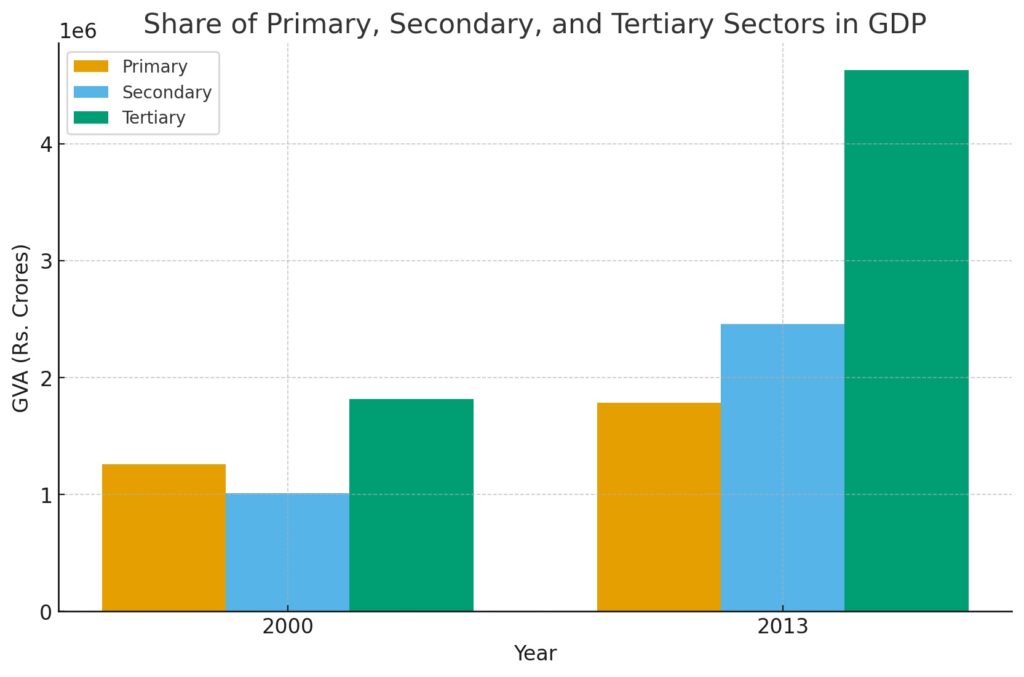
Q24. The following table gives the GVA…
(i) Calculate the share of the three sectors in GDP.
| Year | Primary | Secondary | Tertiary | Total GDP |
|---|---|---|---|---|
| 2000 | 12,56,000 (29.5%) | 10,12,000 (23.7%) | 18,17,000 (42.7%) | 40,85,000 |
| 2013 | 17,87,000 (20.4%) | 24,59,000 (28.0%) | 46,30,000 (52.6%) | 88,76,000 |
(ii) Bar Diagram → (to be drawn in exam: three bars for each year showing shares).
(iii) Conclusion:
- Share of primary sector decreased.
- Share of secondary sector increased.
- Tertiary sector grew the fastest and became the largest contributor to GDP.