Class 7 English Poorvi Unit 2 Animals, Birds, and Dr. Dolittle
Part I
1.
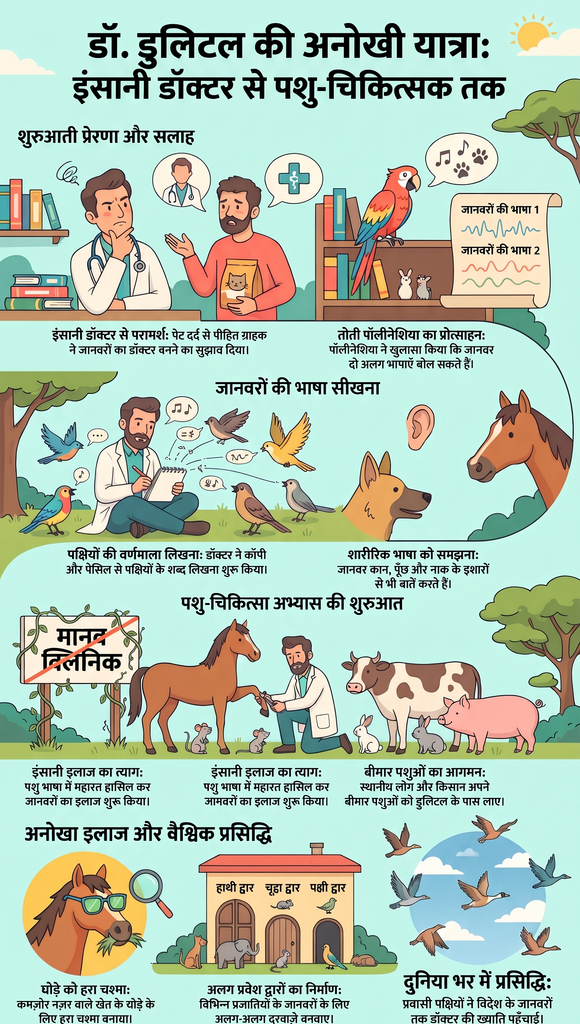
- English: “Doctor Dolittle was sitting in his kitchen talking with the Cat’s-food-Man who had come to see him with a stomach-ache.”
- शब्दार्थ: Kitchen = रसोईघर; Cat’s-food-Man = बिल्लियों का भोजन बेचने वाला व्यक्ति; Stomach-ache = पेट दर्द।
- हिंदी अनुवाद: डॉक्टर डोलिटल अपनी रसोई में बैठकर बिल्लियों का खाना बेचने वाले उस आदमी से बात कर रहे थे, जो पेट दर्द के इलाज के लिए उनसे मिलने आया था।
2.
- English: “Why don’t you give up being a people’s doctor, and be an animal doctor?” asked the Cat’s-food-Man.
- शब्दार्थ: Give up = छोड़ देना/त्यागना; People’s doctor = इंसानों के डॉक्टर; Animal doctor = जानवरों के डॉक्टर।
- हिंदी अनुवाद: “आप इंसानों का डॉक्टर होना छोड़कर जानवरों के डॉक्टर क्यों नहीं बन जाते?” बिल्लियों का खाना बेचने वाले ने पूछा।
3.
- English: “The parrot, Polynesia, was sitting in the window looking out at the rain and singing a sailor song to herself.”
- शब्दार्थ: Parrot = तोता; Window = खिड़की; Sailor song = नाविकों का गीत; To herself = अपने आप में/गुनगुनाते हुए।
- हिंदी अनुवाद: पोलिनेशिया नाम की तोता खिड़की पर बैठी बाहर बारिश को देख रही थी और मन ही मन नाविकों का एक गीत गा रही थी।
4.
- English: “She stopped singing and started to listen.”
- शब्दार्थ: Stopped = बंद कर दिया; Started = शुरू किया; Listen = सुनना।
- हिंदी अनुवाद: उसने गाना बंद कर दिया और ध्यान से सुनने लगी।
5.
- English: “You see, Doctor,” the Cat’s-food-Man went on, “you know all about animals—much more than what these vets here do.”
- शब्दार्थ: Went on = कहना जारी रखा; Vets (veterinarians) = पशु चिकित्सक; Much more = कहीं अधिक।
- हिंदी अनुवाद: “देखिए डॉक्टर,” बिल्लियों का खाना बेचने वाले ने आगे कहा, “आप जानवरों के बारे में सब कुछ जानते हैं—यहाँ के पशु चिकित्सकों की तुलना में कहीं अधिक।”
6.
- English: “That book you wrote—about cats, why, it’s wonderful!”
- शब्दार्थ: Wrote = लिखी थी; Wonderful = अद्भुत/शानदार।
- हिंदी अनुवाद: “बिल्लियों के बारे में आपने जो किताब लिखी थी, अरे वाह, वह तो कमाल की है!”
7.
- English: “I can’t read or write myself—my wife, Theodosia, is a scholar, and she read your book to me.”
- शब्दार्थ: Read or write = पढ़ना या लिखना; Scholar = विदुषी/पढ़ी-लिखी महिला; Read to me = मुझे पढ़कर सुनाई।
- हिंदी अनुवाद: “मैं खुद तो पढ़ना-लिखना नहीं जानता—मेरी पत्नी थियोडोसिया विदुषी है, और उसने आपकी किताब मुझे पढ़कर सुनाई थी।”
8.
- English: “You might have been a cat yourself.”
- शब्दार्थ: Might have been = शायद रहे होंगे; Cat yourself = खुद एक बिल्ली।
- हिंदी अनुवाद: “ऐसा लगता है जैसे आप खुद कभी बिल्ली रहे हों।”
9.
- English: “You know the way they think.”
- शब्दार्थ: The way = जिस तरह; Think = सोचते हैं/विचार करते हैं।
- हिंदी अनुवाद: “आप भली-भाँति जानते हैं कि वे किस प्रकार सोचती हैं।”
10.
- English: “When the Cat’s-food-Man had gone the parrot flew off the window on to the Doctor’s table and said, “That man’s got sense.”
- शब्दार्थ: Flew off = उड़कर आई; Doctor’s table = डॉक्टर की मेज़; Got sense = समझदारी की बात कही/अक्ल होना।
- हिंदी अनुवाद: जब बिल्लियों का खाना बेचने वाला व्यक्ति चला गया, तो तोता खिड़की से उड़कर डॉक्टर की मेज़ पर आ बैठी और बोली, “उस आदमी में समझ है।”
11.
- English: “That’s what you ought to do.”
- शब्दार्थ: Ought to do = करना चाहिए।
- हिंदी अनुवाद: “आपको वही करना चाहिए।”
12.
- English: “Be an animal doctor.”
- शब्दार्थ: Be = बनिए; Animal doctor = जानवरों के डॉक्टर।
- हिंदी अनुवाद: “जानवरों के डॉक्टर बनिए।”
13.
- English: “Give the silly people up—if they haven’t brains enough to see you’re the best doctor in the world.”
- शब्दार्थ: Silly people = मूर्ख लोग; Brains enough = पर्याप्त समझ/बुद्धि; Best doctor = सर्वश्रेष्ठ डॉक्टर।
- हिंदी अनुवाद: “इन नासमझ लोगों को छोड़िए—यदि उनके पास इतनी भी समझ नहीं है कि वे देख सकें कि आप दुनिया के सबसे बेहतरीन डॉक्टर हैं।”
14.
- English: “Take care of animals instead—they’ll soon find it out.”
- शब्दार्थ: Take care of = देखभाल/इलाज करना; Instead = इसके बजाय; Find it out = जान/पहचान लेंगे।
- हिंदी अनुवाद: “इसके बजाय जानवरों की देखभाल कीजिए—वे जल्द ही आपकी कद्र पहचान लेंगे।”
15.
- English: “Be an animal doctor.”
- शब्दार्थ: Animal doctor = पशु चिकित्सक/जानवरों के डॉक्टर।
- हिंदी अनुवाद: “जानवरों के डॉक्टर बन जाइए।”
16.
- English: “Oh, there are plenty of animal doctors,” said John Dolittle, putting the flowerpots outside on the windowsill to get the rain.
- शब्दार्थ: Plenty of = बहुत सारे; Flowerpots = गमले; Windowsill = खिड़की की मुंडेर/चौखट; Get the rain = बारिश का पानी मिलने के लिए।
- हिंदी अनुवाद: “अरे, जानवरों के तो बहुत सारे डॉक्टर हैं,” जॉन डोलिटल ने गमलों को बारिश का पानी मिलने के लिए खिड़की की मुंडेर पर बाहर रखते हुए कहा।
17.
- English: “Yes, there are plenty,” said Polynesia.
- शब्दार्थ: Plenty = बहुत सारे।
- हिंदी अनुवाद: “हाँ, हैं तो बहुत सारे,” पोलिनेशिया ने कहा।
18.
- English: “But none of them are any good at all.”
- शब्दार्थ: None of them = उनमें से कोई भी नहीं; Any good at all = ज़रा भी काम का/अच्छा।
- हिंदी अनुवाद: “लेकिन उनमें से कोई भी किसी काम का नहीं है।”
19.
- English: “Now listen, Doctor, and I’ll tell you something.”
- शब्दार्थ: Listen = सुनिए; Tell you something = आपको एक बात बताती हूँ।
- हिंदी अनुवाद: “अब सुनिए डॉक्टर, मैं आपको एक बात बताती हूँ।”
20.
- English: “Did you know that animals can talk?”
- शब्दार्थ: Did you know = क्या आप जानते थे; Can talk = बोल सकते हैं।
- हिंदी अनुवाद: “क्या आप जानते थे कि जानवर भी बोल सकते हैं?”
21.
- English: “I knew that parrots can talk,” said the Doctor.
- शब्दार्थ: Knew = जानता था; Parrots = तोते।
- हिंदी अनुवाद: “मैं यह तो जानता था कि तोते बोल सकते हैं,” डॉक्टर ने कहा।
22.
- English: “Oh, we parrots can talk in two languages—people’s language and bird language,” said Polynesia proudly.
- शब्दार्थ: Two languages = दो भाषाएँ; People’s language = इंसानों की भाषा; Bird language = पक्षियों की भाषा; Proudly = गर्व से।
- हिंदी अनुवाद: “अरे, हम तोते दो भाषाओं में बात कर सकते हैं—इंसानों की भाषा और पक्षियों की भाषा,” पोलिनेशिया ने गर्व से कहा।
23.
- English: “If I say, ‘Polly wants a cracker’, you understand me.”
- शब्दार्थ: Polly = पोलिनेशिया (तोते का नाम); Cracker = सूखा बिस्कुट (जो चीज़ के साथ खाया जाता है); Understand = समझ जाते हैं।
- हिंदी अनुवाद: “अगर मैं कहूँ, ‘पॉली को बिस्कुट चाहिए’, तो आप मुझे समझ जाते हैं।”
24.
- English: “But hear this: Ka-ka oi-ee, fee-fee?”
- शब्दार्थ: Hear this = इसे सुनिए; Ka-ka oi-ee, fee-fee = पक्षियों की बोली के शब्द।
- हिंदी अनुवाद: “लेकिन इसे सुनिए: का-का ओइ-ई, फी-फी?”
25.
- English: “Good Gracious!” cried the Doctor.
- शब्दार्थ: Good Gracious = हे भगवान!/अरे बाप रे! (आश्चर्य सूचक); Cried = हैरानी से पुकारा/कहा।
- हिंदी अनुवाद: “हे भगवान!” डॉक्टर आश्चर्य से चिल्लाए।
26.
- English: “What does that mean?”
- शब्दार्थ: What does that mean = इसका क्या मतलब है?
- हिंदी अनुवाद: “इसका क्या मतलब है?”
27.
- English: “That means, ‘Is the porridge hot yet?’—in bird language.”
- शब्दार्थ: Porridge = दलिया; Hot yet = क्या अभी गर्म है; Bird language = पक्षियों की भाषा।
- हिंदी अनुवाद: “पक्षियों की भाषा में इसका मतलब है, ‘क्या दलिया अभी गर्म है?'”
28.
- English: “My! You don’t say so!” said the Doctor.
- शब्दार्थ: My! = अरे!; You don’t say so = सचमुच!/क्या बात कर रही हो! (आश्चर्य व्यक्त करना)।
- हिंदी अनुवाद: “अरे! सचमुच!” डॉक्टर ने कहा।
29.
- English: “You never talked that way to me before.”
- शब्दार्थ: Never = कभी नहीं; That way = उस तरह से; Before = पहले।
- हिंदी अनुवाद: “तुमने मुझसे पहले कभी इस तरह बात नहीं की थी।”
30.
- English: “What would have been the good?” said Polynesia, dusting some cracker crumbs off her left wing.
- शब्दार्थ: What would have been the good = भला क्या फायदा होता?; Dusting off = झाड़ते हुए; Cracker crumbs = बिस्कुट के टुकड़े/चूरा; Left wing = बायाँ पंख।
- हिंदी अनुवाद: “भला उससे क्या फायदा होता?” पोलिनेशिया ने अपने बाएँ पंख से बिस्कुट के चूरे को झाड़ते हुए कहा।
31.
- English: “You wouldn’t have understood me if I had.”
- शब्दार्थ: Understood = समझ पाते; If I had = अगर मैंने की भी होती।
- हिंदी अनुवाद: “अगर मैं करती भी, तो आप मेरी बात समझ नहीं पाते।”
32.
- English: “Tell me some more,” said the Doctor, all excited; and he rushed over to the drawer and came back with a book and a pencil.
- शब्दार्थ: All excited = पूरी तरह उत्साहित होकर; Rushed over = तेजी से लपके; Drawer = दराज़; Book and pencil = कॉपी और पेंसिल।
- हिंदी अनुवाद: “मुझे कुछ और बताओ,” डॉक्टर ने पूरी तरह उत्साहित होकर कहा; और वे तुरंत दराज़ की ओर दौड़े तथा एक कॉपी और पेंसिल लेकर लौटे।
33.
- English: “Now don’t go too fast—and I’ll write it down.”
- शब्दार्थ: Too fast = बहुत तेज़; Write it down = लिख लूँगा/दर्ज कर लूँगा।
- हिंदी अनुवाद: “अब बहुत तेज़ी से मत बोलना—और मैं इसे लिखता जाऊँगा।”
34.
- English: “This is interesting—very interesting—something quite new.”
- शब्दार्थ: Interesting = रोचक/दिलचस्प; Quite new = बिल्कुल नया।
- हिंदी अनुवाद: “यह बहुत दिलचस्प है—बेहद दिलचस्प—बिल्कुल नई चीज़ है।”
35.
- English: “Give me the Birds’ A.B.C. first—slowly now.”
- शब्दार्थ: Birds’ A.B.C. = पक्षियों की वर्णमाला/शुरुआती शब्द; Slowly = धीरे-धीरे।
- हिंदी अनुवाद: “पहले मुझे पक्षियों की शुरुआती वर्णमाला बताओ—अब ज़रा धीरे-धीरे बोलना।”
36.
- English: “So that was the way the Doctor came to know that animals had a language of their own and could talk to one another.”
- शब्दार्थ: Came to know = पता चला/सीखा; Language of their own = उनकी अपनी भाषा; One another = एक-दूसरे से।
- हिंदी अनुवाद: तो इस तरह डॉक्टर को पता चला कि जानवरों की भी अपनी एक भाषा होती है और वे एक-दूसरे से बात कर सकते हैं।
37.
- English: “And all that afternoon, while it was raining, Polynesia sat on the kitchen table giving him bird words to put down in the book.”
- शब्दार्थ: All that afternoon = उस पूरी दोपहर; While it was raining = जब बारिश हो रही थी; Put down = लिखना/दर्ज करना।
- हिंदी अनुवाद: और उस पूरी दोपहर, जब बाहर बारिश हो रही थी, पोलिनेशिया रसोई की मेज़ पर बैठी डॉक्टर को कॉपी में लिखने के लिए पक्षियों के शब्द सिखाती रही।
38.
- English: “At teatime, when the dog, Jip, came in, the parrot said to the Doctor, “See, he’s talking to you.”
- शब्दार्थ: Teatime = चाय का समय; Jip = जिप (कुत्ते का नाम); Talking to you = आपसे बात कर रहा है।
- हिंदी अनुवाद: चाय के समय, जब जिप नाम का कुत्ता अंदर आया, तो तोते ने डॉक्टर से कहा, “देखिए, वह आपसे बात कर रहा है।”
39.
- English: “Looks to me as though he were scratching his ear,” said the Doctor.
- शब्दार्थ: Looks to me = मुझे तो ऐसा लगता है; As though = मानो/जैसे कि; Scratching = खुजला रहा हो।
- हिंदी अनुवाद: “मुझे तो ऐसा लग रहा है मानो वह अपना कान खुजला रहा हो,” डॉक्टर ने कहा।
40.
- English: “But animals don’t always speak with their mouths,” said the parrot in a high voice, raising her eyebrows.
- शब्दार्थ: In a high voice = ऊँची आवाज़ में; Raising her eyebrows = अपनी भौंहें चढ़ाते हुए/उचकाते हुए।
- हिंदी अनुवाद: “लेकिन जानवर हमेशा अपने मुँह से ही नहीं बोलते,” तोते ने अपनी भौंहें चढ़ाते हुए ऊँची आवाज़ में कहा।
41.
- English: “They talk with their ears, with their feet, with their tails—with everything.”
- शब्दार्थ: Ears = कान; Feet = पैर; Tails = पूँछ; With everything = हर अंग से।
- हिंदी अनुवाद: “वे अपने कानों से, अपने पैरों से, अपनी पूँछ से—अपने हर अंग से बात करते हैं।”
42.
- English: “Sometimes they don’t want to make a noise.”
- शब्दार्थ: Sometimes = कभी-कभी; Make a noise = आवाज़ निकालना/शोर करना।
- हिंदी अनुवाद: “कभी-कभी वे कोई आवाज़ नहीं करना चाहते।”
43.
- English: “Do you see now the way he’s twitching up one side of his nose?”
- शब्दार्थ: Twitching up = फड़का रहा है/हिला रहा है; One side of his nose = अपनी नाक का एक हिस्सा।
- हिंदी अनुवाद: “क्या अब आप देख रहे हैं कि वह अपनी नाक के एक हिस्से को किस प्रकार सिकोड़ और फड़का रहा है?”
44.
- English: “What’s that mean?” asked the Doctor.
- शब्दार्थ: What’s that mean = इसका क्या अर्थ है?
- हिंदी अनुवाद: “उसका क्या मतलब है?” डॉक्टर ने पूछा।
45.
- English: “That means, ‘Can’t you see that it has stopped raining?’” Polynesia answered.
- शब्दार्थ: Stopped raining = बारिश रुक चुकी है; Answered = उत्तर दिया।
- हिंदी अनुवाद: “उसका मतलब है, ‘क्या आप देख नहीं सकते कि बारिश रुक गई है?'” पोलिनेशिया ने उत्तर दिया।
46.
- English: “He is asking you a question.”
- शब्दार्थ: Asking a question = सवाल पूछ रहा है।
- हिंदी अनुवाद: “वह आपसे एक सवाल पूछ रहा है।”
47.
- English: “Dogs nearly always use their noses for asking questions.”
- शब्दार्थ: Nearly always = लगभग हमेशा; Use their noses = अपनी नाक का इस्तेमाल करते हैं।
- हिंदी अनुवाद: “कुत्ते सवाल पूछने के लिए लगभग हमेशा अपनी नाक का उपयोग करते हैं।”
48.
- English: “After a while, with the parrot’s help, the Doctor got to learn the language of the animals so well that he could talk to them himself and understand everything they said.”
- शब्दार्थ: After a while = कुछ समय बाद; Got to learn = सीख ली; So well = इतनी अच्छी तरह से।
- हिंदी अनुवाद: कुछ समय बाद, तोते की मदद से, डॉक्टर ने जानवरों की भाषा इतनी अच्छी तरह सीख ली कि वे खुद उनसे बात कर सकते थे और उनकी कही हर बात समझ सकते थे।
49.
- English: “Then he gave up being a people’s doctor altogether.”
- शब्दार्थ: Altogether = पूरी तरह से; Gave up = छोड़ दिया।
- हिंदी अनुवाद: फिर उन्होंने इंसानों का इलाज करना पूरी तरह छोड़ दिया।
Part II
50.
- English: “As soon as the Cat’s-food-Man had told everyone that John Dolittle was going to become an animal doctor, old ladies began to bring him their pet pugs and poodles who had eaten too much cake; and farmers came many miles to show him sick cows and sheep.”
- शब्दार्थ: As soon as = जैसे ही; Pugs and poodles = पग और पूडल (कुत्तों की नस्लें); Farmers = किसान; Sick cows and sheep = बीमार गायें और भेड़ें।
- हिंदी अनुवाद: जैसे ही बिल्लियों का खाना बेचने वाले ने सबको बताया कि जॉन डोलिटल जानवरों के डॉक्टर बनने जा रहे हैं, बूढ़ी महिलाएँ अपने उन पालतू पग और पूडल कुत्तों को लाने लगीं जिन्होंने ज़रूरत से ज़्यादा केक खा लिया था; और किसान अपनी बीमार गायों और भेड़ों को दिखाने के लिए मीलों दूर से आने लगे।
51.
- English: “One day a plough horse was brought to him; and the poor thing was terribly glad to find a man who could talk in horse language.”
- शब्दार्थ: Plough horse = हल जोतने वाला घोड़ा; Poor thing = बेचारा जीव; Terribly glad = बहुत अधिक प्रसन्न/खुश; Horse language = घोड़ों की भाषा।
- हिंदी अनुवाद: एक दिन एक हल जोतने वाले घोड़े को उनके पास लाया गया; और वह बेचारा एक ऐसे इंसान को पाकर बेहद खुश हुआ जो घोड़ों की भाषा में बात कर सकता था।
52.
- English: “You know, Doctor,” said the horse, “that vet over the hill knows nothing at all.”
- शब्दार्थ: Over the hill = पहाड़ी के उस पार वाला; Knows nothing at all = कुछ भी नहीं जानता।
- हिंदी अनुवाद: “आप जानते हैं डॉक्टर,” घोड़े ने कहा, “उस पहाड़ी के पार रहने वाला पशु चिकित्सक कुछ भी नहीं जानता।”
53.
- English: “He has been treating me six weeks now—for something or the other.”
- शब्दार्थ: Treating me = मेरा इलाज कर रहा है; Something or the other = किसी न किसी चीज़ का।
- हिंदी अनुवाद: “वह अब छह हफ़्तों से मेरा किसी न किसी चीज़ का इलाज कर रहा है।”
54.
- English: “What I need is spectacles.”
- शब्दार्थ: Spectacles = चश्मा; Need = आवश्यकता/ज़रूरत।
- हिंदी अनुवाद: “मुझे जिस चीज़ की ज़रूरत है, वह चश्मा है।”
55.
- English: “I am going blind in one eye.”
- शब्दार्थ: Going blind = अंधा हो रहा हूँ/दिखाई देना बंद हो रहा है।
- हिंदी अनुवाद: “मेरी एक आँख से दिखना बंद हो रहा है।”
56.
- English: “There’s no reason why horses shouldn’t wear glasses, the same as people.”
- शब्दार्थ: No reason = कोई कारण नहीं; Wear glasses = चश्मा पहनना; The same as people = इंसानों की तरह ही।
- हिंदी अनुवाद: “ऐसा कोई कारण नहीं है कि इंसान की तरह घोड़े चश्मा न पहन सकें।”
57.
- English: “But that stupid man over the hill never even looked at my eyes.”
- शब्दार्थ: Stupid man = बेवकूफ आदमी; Never even looked = कभी देखा तक नहीं।
- हिंदी अनुवाद: “लेकिन उस पहाड़ी वाले बेवकूफ आदमी ने मेरी आँखों की तरफ़ कभी देखा तक नहीं।”
58.
- English: “He kept on giving me big pills.”
- शब्दार्थ: Kept on giving = देता ही रहा; Big pills = बड़ी-बड़ी गोलियाँ/दवाइयाँ।
- हिंदी अनुवाद: “वह मुझे लगातार बड़ी-बड़ी गोलियाँ देता रहा।”
59.
- English: “I tried to tell him, but he couldn’t understand a word of horse language.”
- शब्दार्थ: Tried to tell = बताने की कोशिश की; Understand a word = एक शब्द भी समझना।
- हिंदी अनुवाद: “मैंने उसे बताने की कोशिश की, लेकिन वह घोड़ों की भाषा का एक शब्द भी नहीं समझ सका।”
60.
- English: “What I need is spectacles.”
- शब्दार्थ: Spectacles = चश्मा।
- हिंदी अनुवाद: “मुझे तो चश्मे की ज़रूरत है।”
61.
- English: “Of course—of course,” said the Doctor.
- शब्दार्थ: Of course = बेशक/ज़रूर।
- हिंदी अनुवाद: “बेशक—ज़रूर,” डॉक्टर ने कहा।
62.
- English: “I’ll get you some at once.”
- शब्दार्थ: At once = तुरंत/अभी।
- हिंदी अनुवाद: “मैं तुरंत तुम्हारे लिए चश्मा ले आता हूँ।”
63.
- English: “I would like a pair like yours,” said the horse—“only green.”
- शब्दार्थ: A pair like yours = आपके जैसा एक जोड़ा (चश्मा); Only green = केवल हरे रंग का।
- हिंदी अनुवाद: “मुझे आपके जैसा ही एक चश्मा चाहिए,” घोड़े ने कहा—”बस हरे रंग का हो।”
64.
- English: “They’ll keep the Sun out of my eyes while I’m ploughing the field.”
- शब्दार्थ: Keep the Sun out = धूप से बचाएगा; Ploughing the field = खेत जोतते समय।
- हिंदी अनुवाद: “खेत जोतते समय वह मेरी आँखों को धूप से बचाएगा।”
65.
- English: “Certainly,” said the Doctor.
- शब्दार्थ: Certainly = अवश्य/निश्चय ही।
- हिंदी अनुवाद: “अवश्य,” डॉक्टर ने कहा।
66.
- English: “Green ones you shall have.”
- शब्दार्थ: You shall have = तुम्हें मिलेगा।
- हिंदी अनुवाद: “तुम्हें हरा चश्मा ही मिलेगा।”
67.
- English: “You know, the trouble is, Sir,” said the plough horse as the Doctor opened the front door to let him out—“the trouble is that anybody thinks he can doctor animals—just because the animals don’t complain.”
- शब्दार्थ: The trouble is = परेशानी यह है; Doctor animals = जानवरों का इलाज करना; Complain = शिकायत करना।
- हिंदी अनुवाद: “आप जानते हैं श्रीमान, असली परेशानी क्या है,” खेत जोतने वाले घोड़े ने बाहर निकलने के लिए डॉक्टर द्वारा मुख्य दरवाज़ा खोलते ही कहा—”परेशानी यह है कि कोई भी सोचता है कि वह जानवरों का इलाज कर सकता है—सिर्फ़ इसलिए क्योंकि जानवर शिकायत नहीं करते।”
68.
- English: “As a matter of fact, it takes a much cleverer man to be a really good animal doctor than it does to be a good people’s doctor.”
- शब्दार्थ: As a matter of fact = वास्तव में/असल में; Cleverer man = अधिक बुद्धिमान/चतुर व्यक्ति; Really good = सच्चा और अच्छा।
- हिंदी अनुवाद: “वास्तव में, इंसानों का एक अच्छा डॉक्टर बनने की तुलना में जानवरों का वास्तव में अच्छा डॉक्टर बनने के लिए कहीं अधिक बुद्धिमान व्यक्ति की आवश्यकता होती है।”
69.
- English: “Well, well!” said the Doctor.
- शब्दार्थ: Well, well! = अच्छा, अच्छा!/अरे वाह!
- हिंदी अनुवाद: “अच्छा, अच्छा!” डॉक्टर ने कहा।
70.
- English: “When will my glasses be ready?”
- शब्दार्थ: Ready = तैयार।
- हिंदी अनुवाद: “मेरा चश्मा कब तक तैयार हो जाएगा?”
71.
- English: “I’ll have them for you next week,” said the Doctor.
- शब्दार्थ: Next week = अगले सप्ताह।
- हिंदी अनुवाद: “मैं अगले हफ़्ते तुम्हारे लिए इसे तैयार रखूँगा,” डॉक्टर ने कहा।
72.
- English: “Come in again Tuesday—Good morning!”
- शब्दार्थ: Come in again = दोबारा आना; Tuesday = मंगलवार; Good morning = शुभ प्रभात/नमस्ते।
- हिंदी अनुवाद: “मंगलवार को फिर आना—शुभ प्रभात!”
73.
- English: “Then John Dolittle got a fine, big pair of green spectacles; and the plough horse stopped going blind in one eye and could see as well as ever.”
- शब्दार्थ: Fine, big pair = बढ़िया, बड़ा चश्मा; Stopped going blind = अंधा होना रुक गया; As well as ever = पहले की ही तरह अच्छी तरह।
- हिंदी अनुवाद: फिर जॉन डोलिटल ने एक बढ़िया, बड़ा हरा चश्मा हासिल किया; और घोड़े की एक आँख से दिखना बंद होना रुक गया तथा वह पहले की तरह ही अच्छी तरह देख पा रहा था।
74.
- English: “And soon it became a common sight to see farm animals wearing glasses in the countryside, round Puddleby; and a blind horse was a thing unknown.”
- शब्दार्थ: Common sight = आम नज़ारा; Farm animals = मवेशी/खेत के जानवर; Countryside = ग्रामीण इलाका; Puddleby = पडलबी (स्थान का नाम); A thing unknown = अनसुनी बात/अज्ञात बात।
- हिंदी अनुवाद: और जल्द ही पडलबी के आसपास ग्रामीण इलाके में खेत के जानवरों का चश्मा पहनना एक आम नज़ारा बन गया; और किसी अंधे घोड़े का होना तो बिल्कुल अनसुनी बात हो गई।
75.
- English: “And so it was with all the other animals that were brought to him.”
- शब्दार्थ: Brought to him = उनके पास लाए गए; All the other animals = बाकी सभी जानवर।
- हिंदी अनुवाद: और उनके पास लाए जाने वाले बाकी सभी जानवरों के साथ भी ऐसा ही हुआ।
76.
- English: “As soon as they found that he could talk their language, they told him where the pain was and how they felt, and of course it was easy for him to cure them.”
- शब्दार्थ: Talk their language = उनकी भाषा बोलना; Where the pain was = दर्द कहाँ था; How they felt = वे कैसा महसूस कर रहे थे; Cure them = उनका इलाज करना/ठीक करना।
- हिंदी अनुवाद: जैसे ही उन्हें पता चला कि डॉक्टर उनकी भाषा में बात कर सकते हैं, उन्होंने उन्हें बताया कि दर्द कहाँ था और वे कैसा महसूस कर रहे थे, और ज़ाहिर तौर पर डॉक्टर के लिए उनका इलाज करना बहुत आसान हो गया।
77.
- English: “Now all these animals went back and told their brothers and friends that there was a doctor in the little house with the big garden who really was a doctor.”
- शब्दार्थ: Went back = वापस गए; Brothers and friends = भाई-बंधु और मित्र; Really was a doctor = जो सचमुच का डॉक्टर था।
- हिंदी अनुवाद: अब ये सभी जानवर वापस गए और अपने साथियों और दोस्तों को बताया कि बड़े बगीचे वाले छोटे से घर में एक ऐसा डॉक्टर है जो सचमुच का डॉक्टर है।
78.
- English: “And whenever any creatures got sick—not only horses and cows and dogs—but all the little things of the fields, like harvest mice, badgers, and bats, all came at once to his house on the edge of the town, so that his big garden was nearly always crowded with animals trying to get in to see him.”
- शब्दार्थ: Creatures = जीव-जंतु; Harvest mice = खेतों के छोटे चूहे; Badgers = बिज्जू; Bats = चमगादड़; On the edge of the town = कस्बे के छोर पर; Crowded = भीड़ से भरा हुआ।
- हिंदी अनुवाद: और जब भी कोई जीव बीमार पड़ता—न केवल घोड़े, गायें और कुत्ते—बल्कि खेतों के सभी छोटे-छोटे जीव जैसे जंगली चूहे, बिज्जू और चमगादड़ भी तुरंत कस्बे के किनारे स्थित उनके घर पहुँच जाते, जिससे उनका बड़ा बगीचा लगभग हमेशा अंदर जाने की कोशिश कर रहे जानवरों की भीड़ से भरा रहता था।
79.
- English: “There were so many that came that he had to have special doors made for the different kinds.”
- शब्दार्थ: Special doors = विशेष दरवाज़े; Different kinds = विभिन्न प्रजातियों/प्रकारों के लिए।
- हिंदी अनुवाद: वहाँ इतने सारे जानवर आने लगे कि उन्हें अलग-अलग प्रजातियों के लिए विशेष दरवाज़े बनवाने पड़े।
80.
- English: “He wrote ‘HORSES’ over the front door, ‘COWS’ over the side door, and ‘SHEEP’ on the kitchen door.”
- शब्दार्थ: Front door = मुख्य दरवाज़ा; Side door = बगल का दरवाज़ा; Kitchen door = रसोई का दरवाज़ा।
- हिंदी अनुवाद: उन्होंने मुख्य दरवाज़े के ऊपर ‘घोड़े’ (HORSES), बगल के दरवाज़े के ऊपर ‘गायें’ (COWS), और रसोई के दरवाज़े पर ‘भेड़ें’ (SHEEP) लिख दिया।
81.
- English: “Each kind of animal had a separate door—even the mice had a tiny tunnel made for them into the cellar, where they waited patiently in rows for the Doctor to come round to them.”
- शब्दार्थ: Separate door = अलग दरवाज़ा; Tiny tunnel = छोटी सुरंग; Cellar = तहख़ाना; Waited patiently = धैर्यपूर्वक प्रतीक्षा करते थे; In rows = कतारों में।
- हिंदी अनुवाद: हर प्रकार के जानवर के लिए एक अलग दरवाज़ा था—यहाँ तक कि चूहों के लिए तहख़ाने में जाने वाली एक छोटी सुरंग बनाई गई थी, जहाँ वे कतारों में बैठकर धैर्यपूर्वक डॉक्टर के आने का इंतज़ार करते थे।
82.
- English: “And so, in a few years’ time, every living thing for miles and miles got to know about John Dolittle, M.D.”
- शब्दार्थ: In a few years’ time = कुछ ही वर्षों में; Every living thing = हर जीव; Miles and miles = मीलों दूर तक।
- हिंदी अनुवाद: और इस प्रकार, कुछ ही वर्षों में मीलों दूर तक का प्रत्येक जीव जॉन डोलिटल, एम.डी. के बारे में जान गया।
83.
- English: “And the birds who flew to other countries in the winter told the animals in foreign lands about Dolittle who could understand their talk and help them in their troubles.”
- शब्दार्थ: Winter = सर्दियाँ; Foreign lands = विदेशी धरती/दूसरे देश; Troubles = परेशानियाँ/मुसीबतें।
- हिंदी अनुवाद: और जो पक्षी सर्दियों में उड़कर दूसरे देशों में जाते थे, वे वहाँ के जानवरों को डोलिटल के बारे में बताते थे जो उनकी भाषा समझ सकते थे और उनकी परेशानियों में उनकी मदद कर सकते थे।
84.
- English: “In this way he became famous among the animals—all over the world.”
- शब्दार्थ: Famous = प्रसिद्ध/मशहूर; Among the animals = जानवरों के बीच; All over the world = पूरी दुनिया में।
- हिंदी अनुवाद: इस तरह वे पूरी दुनिया में जानवरों के बीच मशहूर हो गए।
85.
- English: “He was happy and liked his life very much.”
- शब्दार्थ: Happy = प्रसन्न/खुश; Liked his life = अपना जीवन बहुत पसंद था।
- हिंदी अनुवाद: वे बहुत खुश थे और उन्हें अपना यह जीवन बहुत पसंद था।